The Myth of Paradise: Phi Phi & the Price of a Perfect Picture
Day 15 | Wed Nov 12 – Thailand Travel Diary
Location: Phuket → Phi Phi Islands
Mood: Sun-dazed, skeptical, and a little rage-tanned
The Promise of Paradise
Phi Phi Islands.
The name alone has become shorthand for paradise — those limestone cliffs, teal lagoons, and silky beaches that fill every travel reel. You’ve seen it: some influencer alone on the sand, hair blowing, the only footprints her own.
I knew it wouldn’t be like that.
Still, a part of me hoped.
We’re travelling as a group, which means compromise — something I’ve decided is the key to successful group travel. I had planned to hire a private boat and chase the quiet corners of Thailand beaches, but consensus ruled: the group wanted a tour. So, a tour it was.
The man at the booth promised “a luxury speedboat, smaller group — max thirty-five people.”
There were nearly fifty of us.
Luxury, apparently, is a flexible concept.
Rush Hour to Paradise
The van picked us up at 7:30 a.m. and spent the next hour inching through Phuket traffic toward the Royal Phuket Marina — which, as a former spin instructor, I’ll forever read as “Revolutions Per Minute.”
When we arrived, we joined the usual sea of colour-coded bracelets — red for this boat, blue for that — and a collective bracing for whatever “adventure” meant today.
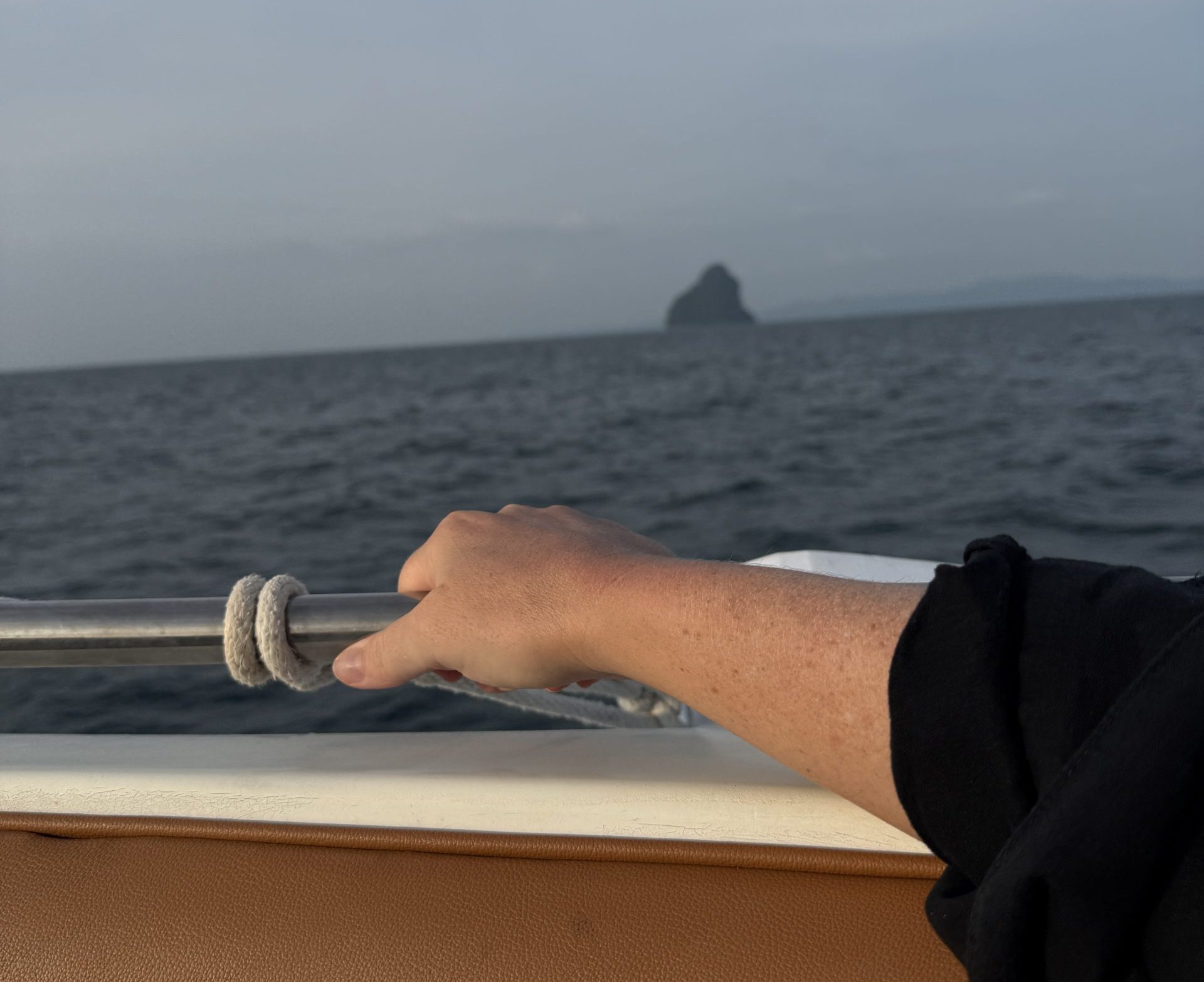
We claimed our spot at the front of the boat because there’s no universe in which my mother and I could handle being inside that sauna of a cabin. This time, luck was on our side: the bow only fit four people. It felt almost private.
The ride out was fabulous — calm water, a gentle breeze, and that early-morning optimism that maybe, just maybe, this won’t be a total circus. We passed long-tail boats bobbing like dragonflies and what looked like a floating restaurant in the middle of the sea — a bar, maybe, with boats docked around it like regulars at happy hour.
For fifty minutes, it was bliss.
The Best Hour of the Day
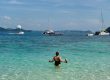
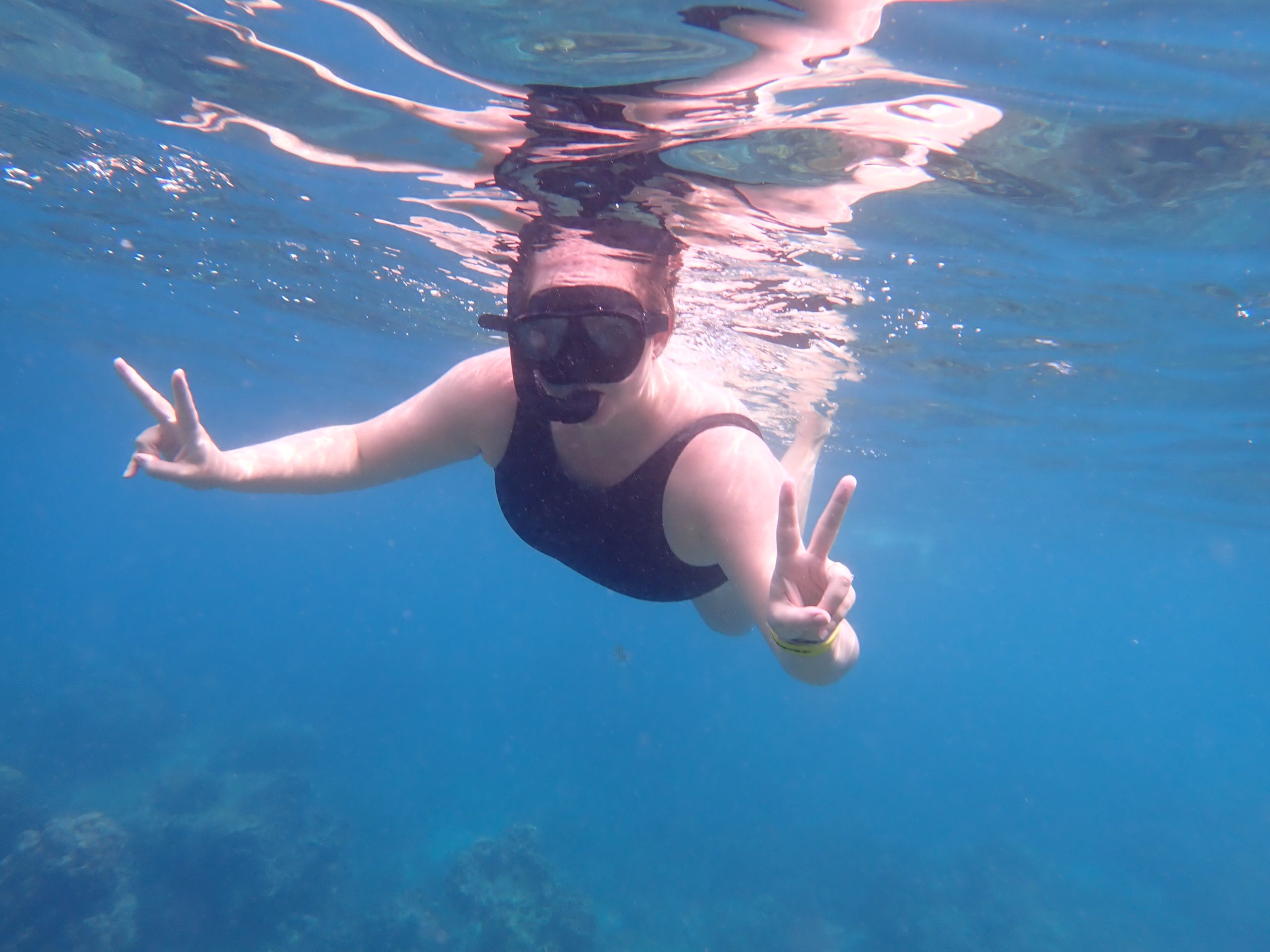
Our first stop was a small reef, and honestly, it was the best part of the entire day. The water was clear, calm, and not full of people — which automatically made it a win. I slipped in and snorkelled for about an hour, watching the fish and trying to soak up the quiet before the inevitable crowds kicked in. It was peaceful and actually felt like the version of Phi Phi you see online.
Then I climbed back on the boat, had to squeeze my way through other passengers (who apparently don’t think it’s appropriate to get out of the way when someone is trying to get through) to find Brent sitting in a cloud of cigarette smoke at the bow. Random people had moved into our seats, trampling over our towels and gear to get a selfie and light up — despite the announcement that this was a “no smoking” boat. The kicker? The crew were smoking too.
Peace, shattered.
Monkey Business
Next up: Monkey Beach.
Sold to us as a “stop to explore the beach and meet the monkeys.” Reality: twenty-five boats idling offshore, engines running, while we stared at a line-up of tourists actually on the sand, blocking the views with their asses. Not me being shitty, just the reality.
“Just look,” our guide said.
So we looked.
At monkeys the size of pixels.
That moment set the tone. Every “stop” after that — Viking Cave, Blue Lagoon, Bamboo Island — was just another version of the same performance: motor in, snap a photo, motor out. The Blue Lagoon might have been breathtaking if not for the flotilla of speedboats and the slick of sunscreen and oil coating the water’s surface.
At one point the sea turned choppy, and our “luxury” boat became a human blender. We were airborne more often than afloat. I genuinely considered asking the captain to slow the hell down.
The Beach (and the Beast)
Then came Maya Bay — the crown jewel. The one from The Beach.
From a distance, it’s everything you want it to be: cliffs rising like cathedral walls, turquoise water glowing from below, perfection personified.
Up close, it’s something else entirely.
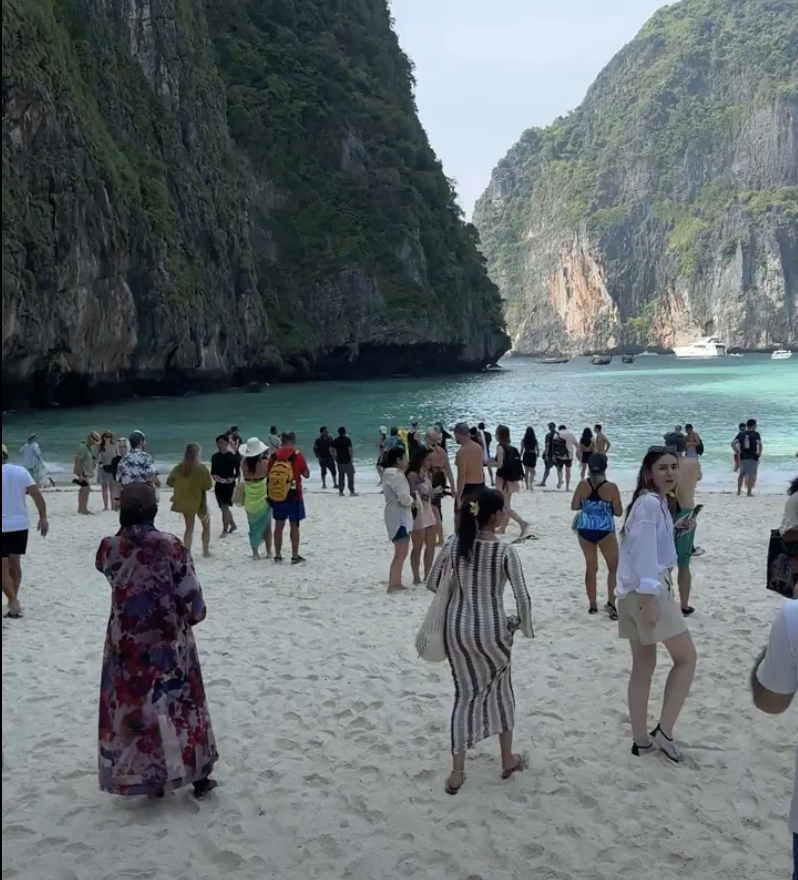
Boats queue nose-to-nose to unload passengers onto a massive floating dock. From there, tourists are funnelled single-file along a boardwalk to reach the beach — where swimming is banned but photo ops are…well, let’s just say the visitors here take the “at any cost” approach to getting the shot. The result? Thousands of tourists standing shoulder to shoulder, all trying to get a photo that looks like they’re alone.
While I waited to reboard the boat, I started counting — seventy-five people walked past me in one minute. At that rate, it felt like tens of thousands must cycle through each day. Later, I looked it up: official park reports show around 5,000–6,000 visitors a day, and more than 1.6 million people in just ten months.
For context, earlier studies suggested Maya Bay’s carrying capacity was only 2,000 visitors per day — the upper limit before environmental damage becomes irreversible. So even the “rehabilitated” version is operating at roughly triple that threshold.
Standing there, it didn’t feel like a protected site. Rangers shouted at people to get out of the water, while others ignored them completely. Some climbed over railings, tossed cigarette butts, or shoved past anyone between them and their perfect selfie.
The numbers explain everything: the park brings in over 648 million baht a year. Conservation is the tagline, but tourism is the business model.
Those peaceful, empty photos of Maya Bay you see online? They’re fiction. You can’t find solitude here — only evidence of what happens when paradise becomes profitable.
The Myth Cracks
After Maya Bay, we stopped at Phi Phi Don — the big island — which, for all its postcard beauty, felt more like a ferry terminal than paradise. The beach was crawling with people, the air thick with the smell of sunscreen and boat fuel, and the soundtrack was a mix of servers trying to sell drinks and tourists who don’t grasp the concept of headphones.
We made the best of it. Went for a swim, grabbed a drink, met a few local cats who were clearly smarter than the tourists, and tried to ignore the buffet situation — another one of those open-air setups where the heat turns your lunch into a sauna. The food wasn’t bad, but eating anything at 35 °C is a test of willpower.
Our final stop was Kai Beach, and by that point, everyone was cooked — literally and metaphorically. Steve went jet-skiing (looked fun, I’ll give him that) while the rest of us stuck to the shade and pretended we hadn’t just been body-slammed by a day of boat tours. The water was beautiful, but even here, every square metre seemed occupied by another tour group trying to wring one more selfie out of the day.
And yet — somewhere between the chaos and the noise — I couldn’t help noticing how stunning it all still was. The limestone cliffs, the fluorescent blues, the sheer geography of the place. It’s not the land that’s the problem; it’s what we’ve done to it.
What We Don’t See on Instagram
By the time we got back to Phuket, I was a crispy little sunfish. The kind that needs a cold shower, aloe, and complete silence. Everyone in our group said some version of, “Glad we did it, but wouldn’t do it again.”
I can’t say I agree. I’m not glad we did it — not in the “check it off the list” way people usually mean. If I could go back, I’d skip the tour completely and spend that day doing less.
Because here’s the truth: you can still see the beauty of Thailand without joining the stampede. You just have to look for it differently. Maybe that means hiring a private boat, finding local operators who don’t herd you from one “highlight” to another, or simply accepting that some of the most beautiful places aren’t meant to be accessible to everyone all at once.
And yes, I know how privileged that sounds. But it’s also honest. These islands aren’t being loved; they’re being consumed. And we all play a part in that — even the ones who hate it.
The truth is, I don’t have the solution yet. Private boats exist, but language barriers and logistics make it tricky. The online options — Viator, Get Your Guide — still follow the same overcrowded routes. And I get it: locals are probably protective of their quieter coves. We do the same at home in Nova Scotia — we keep our “sacred places” off Google Maps so they stay sacred.
It’s a Catch-22. We want to experience beauty, but the act of experiencing it changes it.
Final Thoughts
I’ve been trying to make sense of how I feel about Phi Phi — and honestly, I’m still not sure. Part of me feels lucky to have seen it at all; the other part wishes I hadn’t. Because once you’ve seen how “paradise” actually operates, it’s hard to unsee it.
It’s not that Thailand isn’t beautiful. It’s jaw-dropping. But somewhere along the line, beauty became a commodity. Every brochure and Instagram reel sells the same lie: that you can still find something untouched if you go soon, pay more, or wake up earlier. But it’s never really untouched — not anymore.
I keep thinking about the 2,000 visitors a day number — what scientists said Maya Bay could sustain without collapsing — and how we’re tripling that because demand is profitable. The line between “sharing” a place and exploiting it feels thinner than ever.
And yet, I’m not sure what the answer is. If fewer people came, fewer locals would make a living. If we all stayed home, places like this would still need protection — just from different threats. There’s no perfect solution here, just trade-offs.
What I do know is that this confirmed my lack of desire to ever do a big group island tour again. I’d rather see less, more slowly, with fewer people. Maybe “less is more” isn’t just a saying — maybe it’s the only way wild places survive.
For now, I’m sunburned, salty, and sitting in the shade with a cold drink, feeling grateful for what I’ve seen and equally certain I never want to see it like this again.
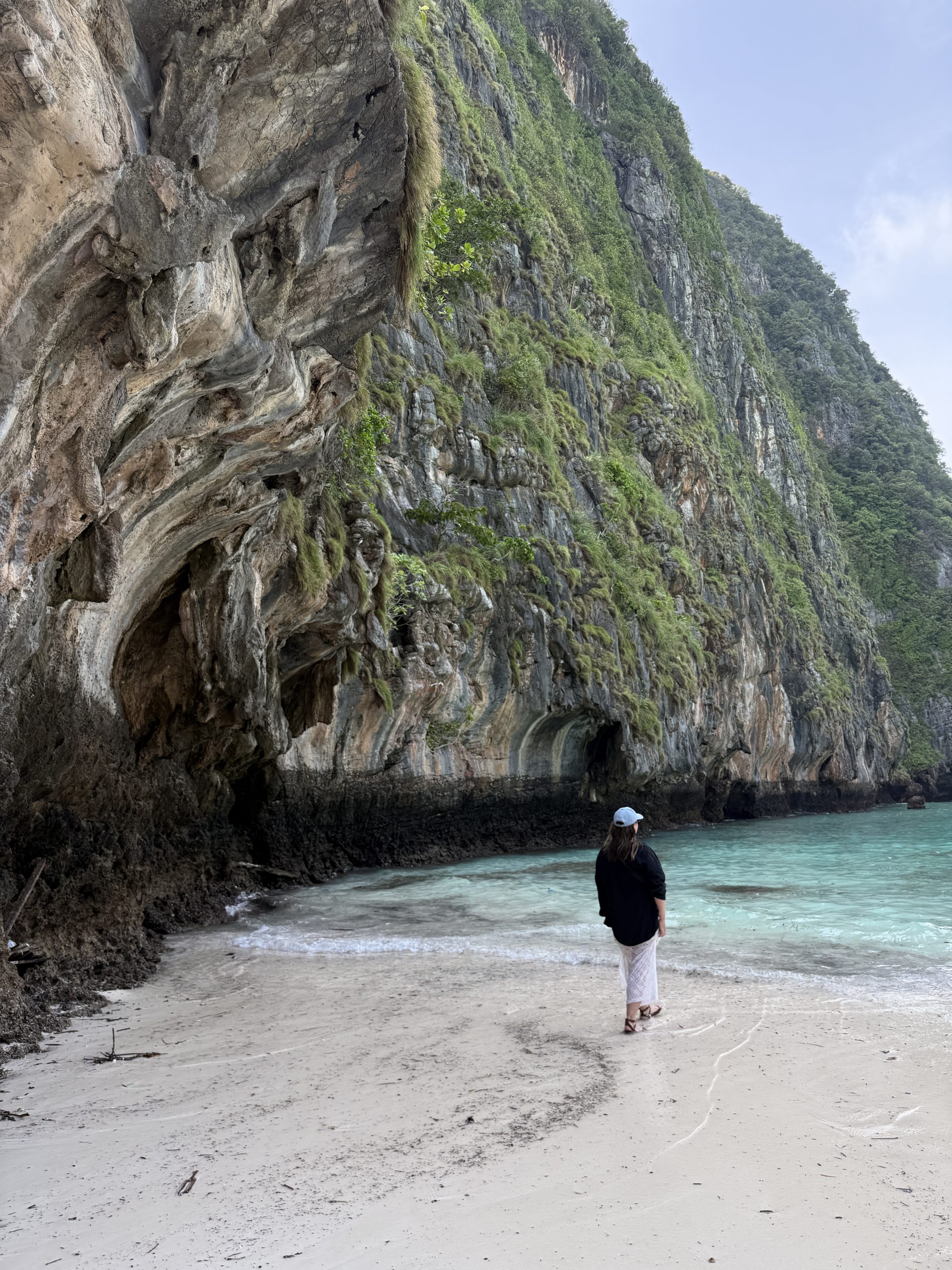
Photo of the Day: Maya Bay — cropped tight enough to hide the truth.
And…the truth:
✈️ Travel Tip of the Day:
If a tour promises “luxury,” ask how many people fit on the boat — then double it. If that number still sounds peaceful, go for it.
Let’s Talk:
Would you still visit places like Maya Bay knowing how overcrowded they’ve become? Is there such a thing as ethical travel when the destination’s already drowning in tourists?
Missed an Entry?
👉 Day 1 – The Uber Ride from Hell
👉 Day 2 – The Lounge Life & the Struggle Bus
👉 Day 3 – Hot, Hotter & Really F*ing Hot
👉 Day 4 – Floating Markets, Boat Noodles & the Great Coke Zero Explosion
👉 Day 5 – Heaven, Hell & the Hands at the White Temple
👉 Day 6 – Hill Tribes, Hard Truths & a Side of Curry
👉 Day 7 – Who Needs Guardrails, Anyway?
👉 Day 8 – Elephant-Sized Moral Hangover
👉 Day 9 – The Great Decaf Drought | Thailand Travel Diary
👉 Day 10 – Rash Decisions & Redemption Arcs | Thailand Travel Diary
👉 Day 11 – The Calm Before the Chaos
👉 Day 12 – Islands, Introspection & the Illusion of Luxury
👉 Day 13 – Fruit, Foot Rubs & Family Conversions
👉 Day 14 – Flip Turns, Weed Bars & Pet Peeves