
Day 8 – Elephant-Sized Moral Hangover | Thailand Travel Diary
Monday, Nov 4 – Day 8, Chiang Mai Province
Location: Chiang Mai → Elephant Rescue Park → Bua Tong Sticky Waterfall → WinTree City Resort
Mood: Elephant-sized moral hangover
Well, here’s a truth you didn’t ask for…
I’ve been on my period for ten days. Ten. Days.
Lucky for me, most of our readers are women, so you’ll get it. But for the men in the room, rather than carry on not talking about these things and keeping them “hidden” like women have (stupidly, in my opinion) done for so long, I’ll say it.
Humans are not meant to bleed for weeks at a time. And when we do, it’s exhausting. My iron is in the toilet (literally). Some people will say this is TMI, and if that’s you, you’re part of the problem. Perimenopause is an asshole. And we should be talking about it.
And still, here I am in northern Thailand, trying to hold space for gratitude, curiosity, and whatever else I’m supposed to be feeling while I quietly fantasize about a heating pad and a nap that lasts a week.
The thing about travel is that it doesn’t pause for your hormones. It doesn’t care if you’re exhausted or overstimulated or fighting with your uterus. You’ve still got temples to climb, waterfalls to slip on, and elephants to meet.
The Elephant in the Room (Literally)
I’ll be honest — I was nervous about today. I’ve wrestled with the ethics of elephant tourism for years, and I still don’t know where I land.
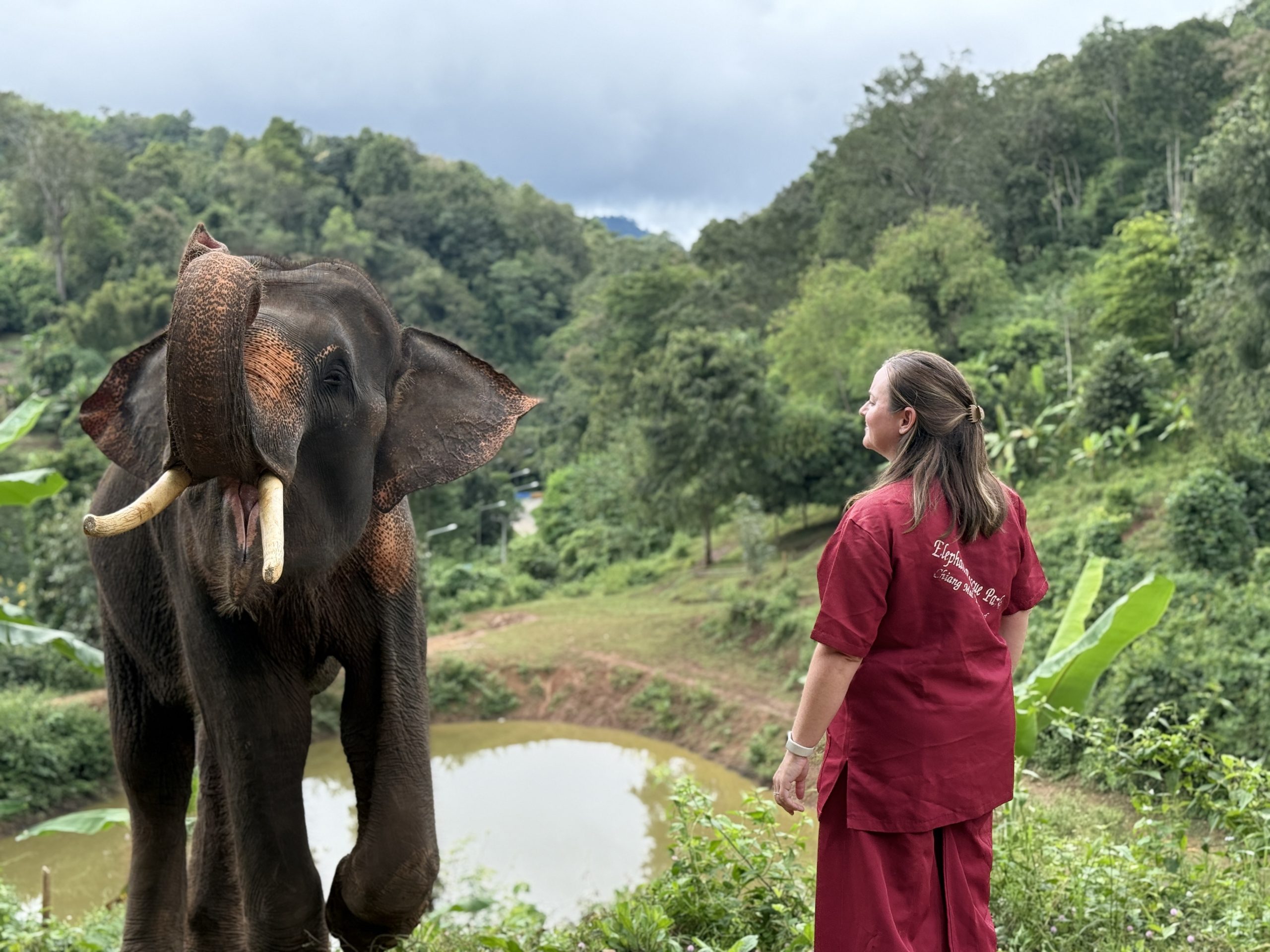
We visited a place called Elephant Rescue Park, and I went in with my guard up. They say they’re ethical. No riding, no baby-touching, which I think is good. Every elephant has a caretaker — a mahout — who lives with them full-time.
It’s a role that’s usually passed down through families, and the bond between them runs deep (according to my own research, coupled with a lot of questions at the Rescue Park). A good mahout isn’t just a handler; he’s a lifelong companion. They bathe, walk, and talk to their elephants every day, often from the time they’re young until one of them dies.
It’s beautiful, but also complicated. In ethical sanctuaries, mahouts act more like guardians, using voice, touch, and trust instead of punishment or control. In less ethical settings, that same relationship can be exploited — which is where things get murky. What struck me most was how emotional the elephants are. They recognize their mahout’s voice, grieve when they’re separated, and even mirror their energy. It’s not ownership; it’s something closer to family.
It seemed gentle. The caretakers appeared kind — not performative — singing softly, touching their elephants affectionately when they didn’t think anyone was watching. I made a point to observe quietly, ask a lot of questions, and listen more than I talked.
What struck me most was how aware elephants are. Their brains are the largest of any land animal — three times the size of ours — and packed with neurons devoted to social and emotional processing. They recognize themselves in mirrors (a rare sign of self-awareness), mourn their dead, comfort distressed herd members, and even perform what researchers call “grief rituals.” They form lifelong family bonds and remember individual humans and elephants decades later.
It’s a lot. And all contributed to my own internal moral struggle.
They told us that some so-called “sanctuaries” rent elephants, which is bad news — those are the ones that move animals around for short-term profit or let tourists “play” with the babies. This place claimed to do neither. These elephants have 50 acres of space and, according to the guides, all have been rescued from logging camps or circuses.
We learned a lot:
These elephants were rescued from logging camps and circuses.
They eat about 10% of their body weight every single day — hundreds of pounds of food.
They go through five sets of teeth in a lifetime, and when the last set wears down, that’s often what kills them — starvation. There’s one older lady here being hand-fed mushy fruit and ground-up plants because she can’t chew anymore.
Their trunks contain around 150,000 muscle fascicles (for context, human muscles have 40–80 fascicles). They can pick up a single peanut or rip a tree from the ground.
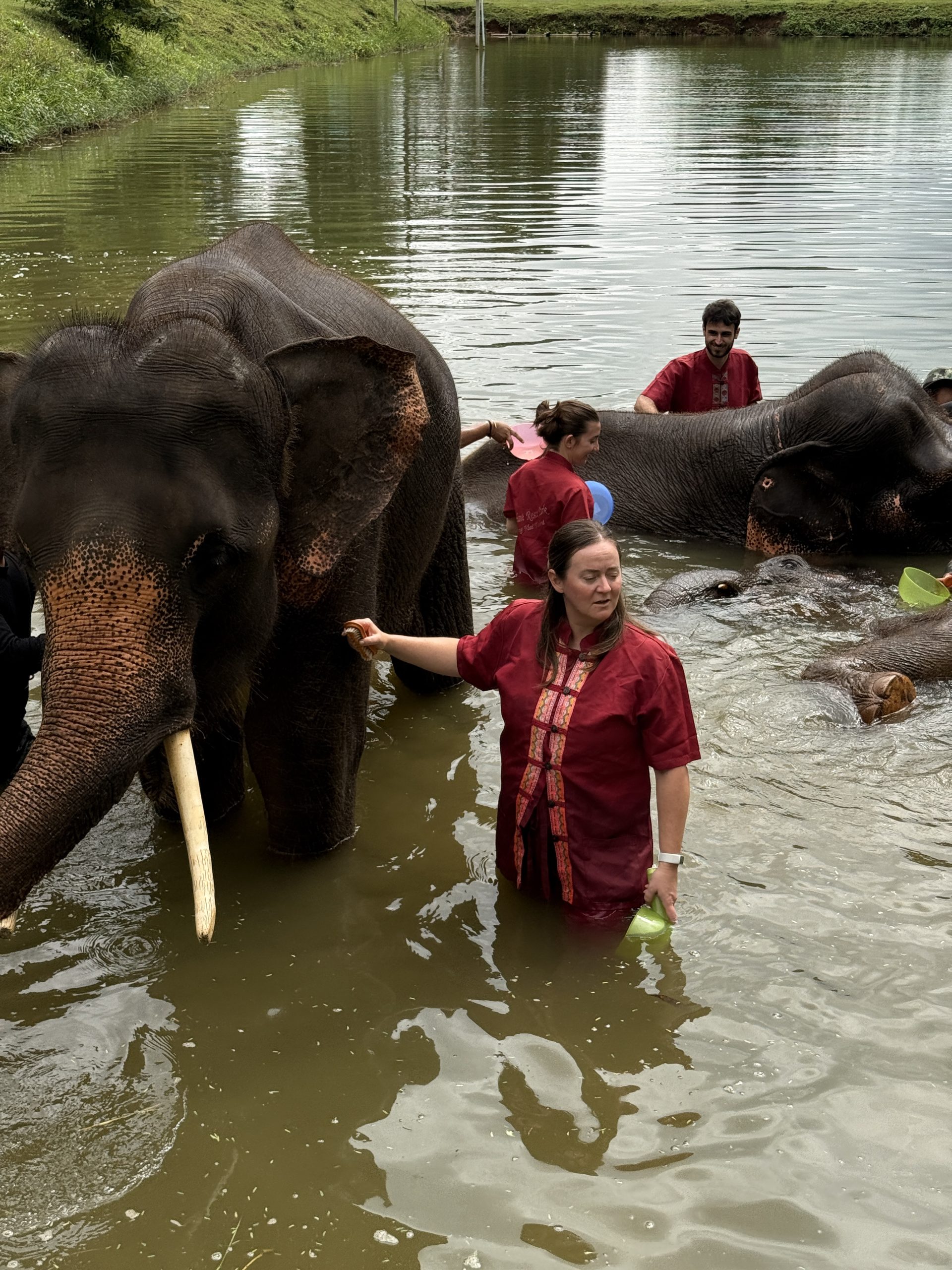
We fed them bananas, which they plucked from our hands with shocking precision, and walked beside them through the forest. They’re hilarious, by the way — each with its own personality. One of them rolled in the river toward me, and Steve immediately panicked, yelling, “Get out of the way!” It looked like I was about to get flattened, but honestly? He was just a buoyant giant. When he bumped into me, it was more like a giant pool toy and didn’t feel like any sort of risk.
Then came something I didn’t love. Andy, our guide, used the command bhundai — it makes the elephants lift their trunks. He said it’s used for health checks. Maybe. But part of me wondered if that’s just the sanctuary version of a party trick (which I think it is). Some of them did it, some didn’t, and the ones that didn’t were left alone — which I appreciated. Still, I can’t shake the question: is that really for their health, or ours? I questioned it — asked how they train them to do that — and he said “it’s automatic”, which is obviously bullshit. Elephants just don’t learn commands, just like dogs don’t learn commands without being taught. Is a command a bad thing? Maybe not. Depending on how it’s being taught. Again, the battle wears on…
That’s the thing about all this. You can’t ever really know.
Even the best sanctuaries are still captivity. Maybe they’re the bridge between extinction and survival, or maybe they’re just a softer version of the same problem. Cambodia has nearly lost all its wild elephants (only a few hundred individuals left) — poaching and habitat loss are wiping them out. Thailand still has a few thousand. Are sanctuaries the only way to protect them now? Is extinction worse than captivity?
It’s easy to sit at home and say “never support animal tourism,” but when you see the reality — the loss of habitat, the logging bans that left thousands of working elephants suddenly homeless — it gets complicated fast.
Elephants are emotional. They grieve. They love. They have families. They remember kindness — and cruelty. Maybe the least-worst option is helping the ones that already exist live out their lives safely, even if it means accepting that wild elephants, as we know them, might not have a future.
I don’t know.
I just hope we made a choice today that did more good than harm.
Two Cafés, Two Realities
Our driver, Tonga, stopped at a coffee shop after. Surprise — it also had elephants. This one didn’t feel right. Their space was smaller, their skin looked dull, and the vibe was just… off. We finished our drinks and left fast. One of the challenges we’re noticing here is the significant language barrier.
It’s difficult to communicate beyond simple requests. For example, we tried to speak with several locals about the ethics of animal sanctuaries and it was challenging to get across what we were and were not comfortable with. I’ve found that, generally speaking, Thai people are super accommodating and just want you to have a good time. It’s definately a culture of “yes” and a bit more challenging to get straight answers.
So, although we went to lengths to find what we thought was an ethical elephant rescue, Tong (who was lovely, by the way) then took us to this elephant cafe which was pretty obviously the opposite of what we’d been going for.
It was like a real-time reminder that “ethical” is sometimes just a line on a brochure.
Sticky Waterfalls & Slippery People
Then came Bua Tong Sticky Waterfall, which social media would have you believe is some hidden jungle oasis where you quietly commune with nature and find yourself in the mist.
In reality, it’s a zoo.
People everywhere — climbing, posing, blocking the path to strike their “lost in nature” stance while a friend yells directions from the sidelines.
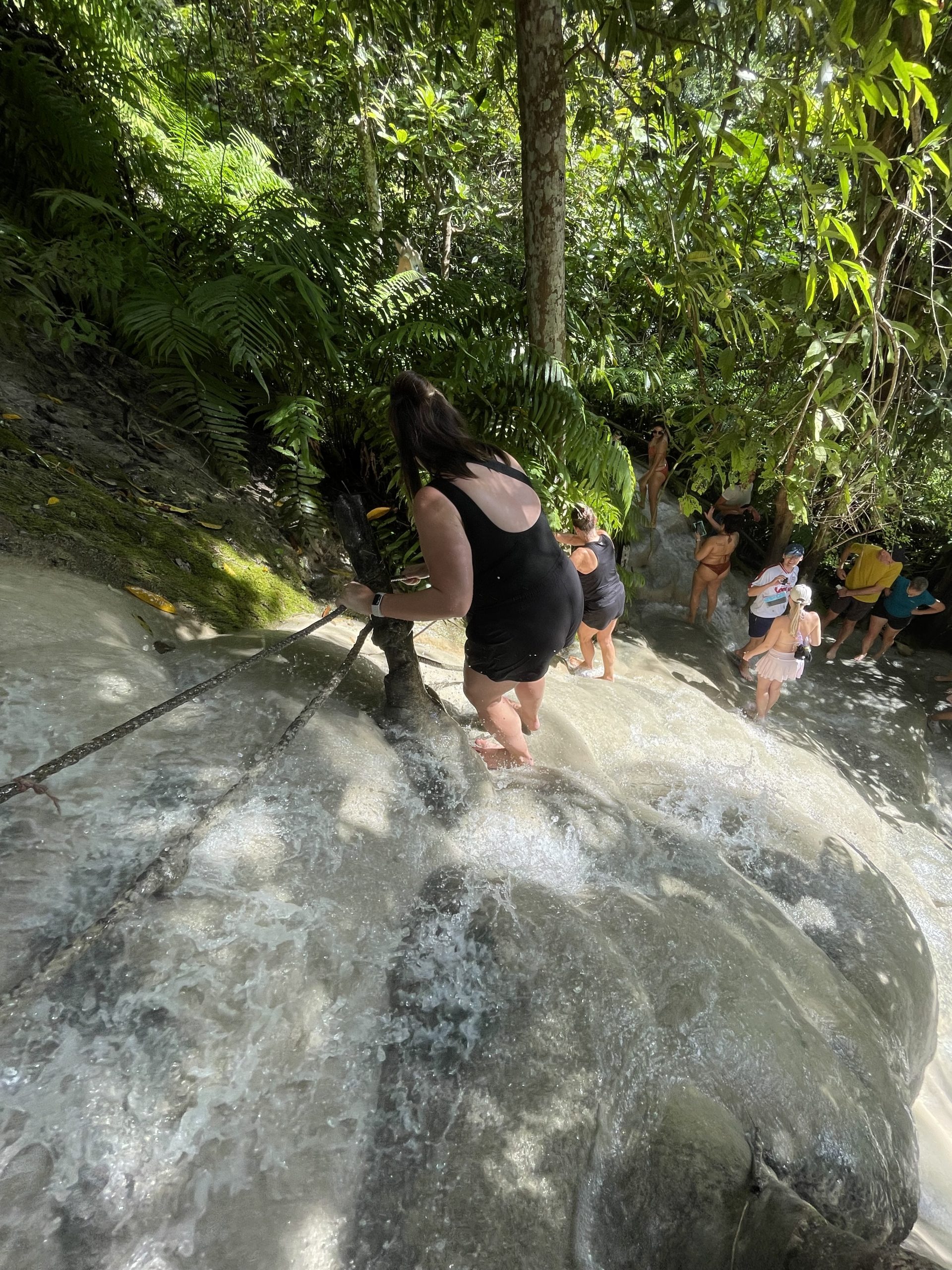
To be fair, the waterfall itself is legitimately fascinating. It’s over 300 feet high and 30° and 50° incline (so no joke). The rocks are coated in a mineral deposit called travertine, formed by calcium carbonate from a nearby spring. That build-up gives the surface a strange, grippy texture — so grippy you can actually walk up the waterfall without slipping. No algae, no slime, just this chalky, natural traction that feels like sandpaper underfoot. The local name, Nam Phu Chet Si, translates to “Spring of Seven Colors” — a nod to the vibrant pools created by the minerals.
This next part might surprise you. The influencers and content creators were the WORST. It was all thongs and a**holes in your face while these women inconvenienced everyone else to “get the shot”. I get it, I’m part of this world too. But this is one of the reasons I cringe when someone calls me an influencer — because there are those of us who create content with the intention of doing so in a non-disruptive way and those who don’t give a sh*t about others and will do whatever it takes.
I will say this: risking your own neck for a photo that looks like they’re alone in paradise is one thing (forget about how misleading this is) but putting others at risk, that’s a no-fly zone for me. This is the dark side of curated travel: the highlight reels, the filters, the illusion of solitude. It’s performative as hell, and I say that as someone who’s been guilty of it too.
Maybe that’s why I’m writing these diaries the way I am — messy, sweaty, unfiltered, sometimes irritated but always real. Because travel isn’t all glowing skin and perfect lighting. It’s crowds, chaos, and trying not to slip while someone blocks the only exit for a selfie.
There’s about a 50 foot section at the very top of the falls that is VERY slippery. As in, there’s no way to safely navitage without ropes but the top is also where people want their photos so there’s a literal traffic jam at the most dangerous point. I had to tell a women to “move it” so we could pass safely.
I started off friendly, asking “are you waiting for something?” and when she replied, “for a picture” I said “well, I’m sorry but you can’t sit there. It’s the only safe path out so you’ll need to wait somwhere else”. Luckily, she moved. I had my mamma with me, so my protective daughter energy came out.
For context, a lot of accidents happen here everyday. You can look that up. While we were there, we watched a man fall at the very top and drop down about 20 feet. He was OK but it could have been bad.
So the lesson is, if you’re going to tackle one of these “instagrammable hotspots”, be careful, pay attention and stay focused. It only takes one slip for catasrophy and a little accident could take out dozens of people further down the falls — sticky or not.
Dinner, Hormones & Humanity
By the time we got back to the hotel, I was running on fumes — physically, emotionally, morally. The day had been one long tug-of-war between awe and discomfort, compassion and fatigue. There’s something about days like this that make you see humanity more clearly — in elephants, in strangers, in yourself. Everyone’s just trying their best, even when it looks messy.
We skipped the Lantern Festival. It looked beautiful, but the crowds were intense, and tickets were running close to $300 USD. Honestly, the thought of elbowing through thousands of people while bleeding through my tenth day of womanhood was… not the vibe. So, we stayed in.
Dinner was a mixed bag: crispy pork belly (stellar), baked mussels (absolutely not), and another Pad Thai because at this point, it’s comfort food. Brent and Steve went for the BBQ, which looked great until I saw the shrimp skewers practically cuddling the chicken. Between that and the communal tongs, it was a no-go for the allergy crew (Mom and me).
We sat there quietly — the kind of tired where you don’t even need to talk — and I realized that this trip, like most of life, is one big balancing act. Wonder and weariness. Ethics and experience. People you adore and people you just… tolerate until they catch their flight home. That’s the thing with group travel. You’re meeting new people all the time. With some of them you’ll click right away, and with others —not so much.
Maybe that’s what travel really does: it doesn’t change you so much as expose you. How you handle fatigue, frustration, and moral hangovers because that’s who you are when no one’s watching.
Photo of the Day:
📸 Me, mid-laugh, mid-scream, as an elephant rolled toward me in the river. Look closely, you can see the cheeky little dude literally rolling around under water. They’re adorably playful!
Missed an entry?
👉 Day 1 – The Uber Ride from Hell
👉 Day 2 – The Lounge Life & the Struggle Bus
👉 Day 3 – Hot, Hotter, & Really F*ing Hot
👉 Day 4 – Floating Markets, Boat Noodles & the Great Coke Zero Explosion
👉 Day 5 – Heaven, Hell & the Hands at the White Temple
👉 Day 6 – Hill Tribes, Hard Truths & a Side of Curry
👉 Day 7 – Who Needs Guardrails, Anyway?
✈️ Travel Tip of the Day:
If someone tells you a place is “peaceful,” assume there’s an influencer doing squats in the background.
Let’s talk:
Would you rather see elephants in sanctuaries, or not at all?
Do you think travel changes people — or just reveals who they already are?
Tell me in the comments. I’m in my feelings today and would love to know where you land.






I would rather see any animal live their best life.
Thank you for your experience and I hope you get through the BS of PM with as little side effects as possible. Love that you keep the conversation up front and centre. You are right…this needs to be talked about.