
Day 7 – Who Needs Guardrails, Anyway? (And Other Lessons from the Jungle Road to Chiang Mai)
Sunday, Nov 3 – Day 7
Location: Chiang Rai → Chiang Mai (via Wat Phra That Doi Suthep)
Mood: Peaceful, reflective, and slightly obsessed with bidets
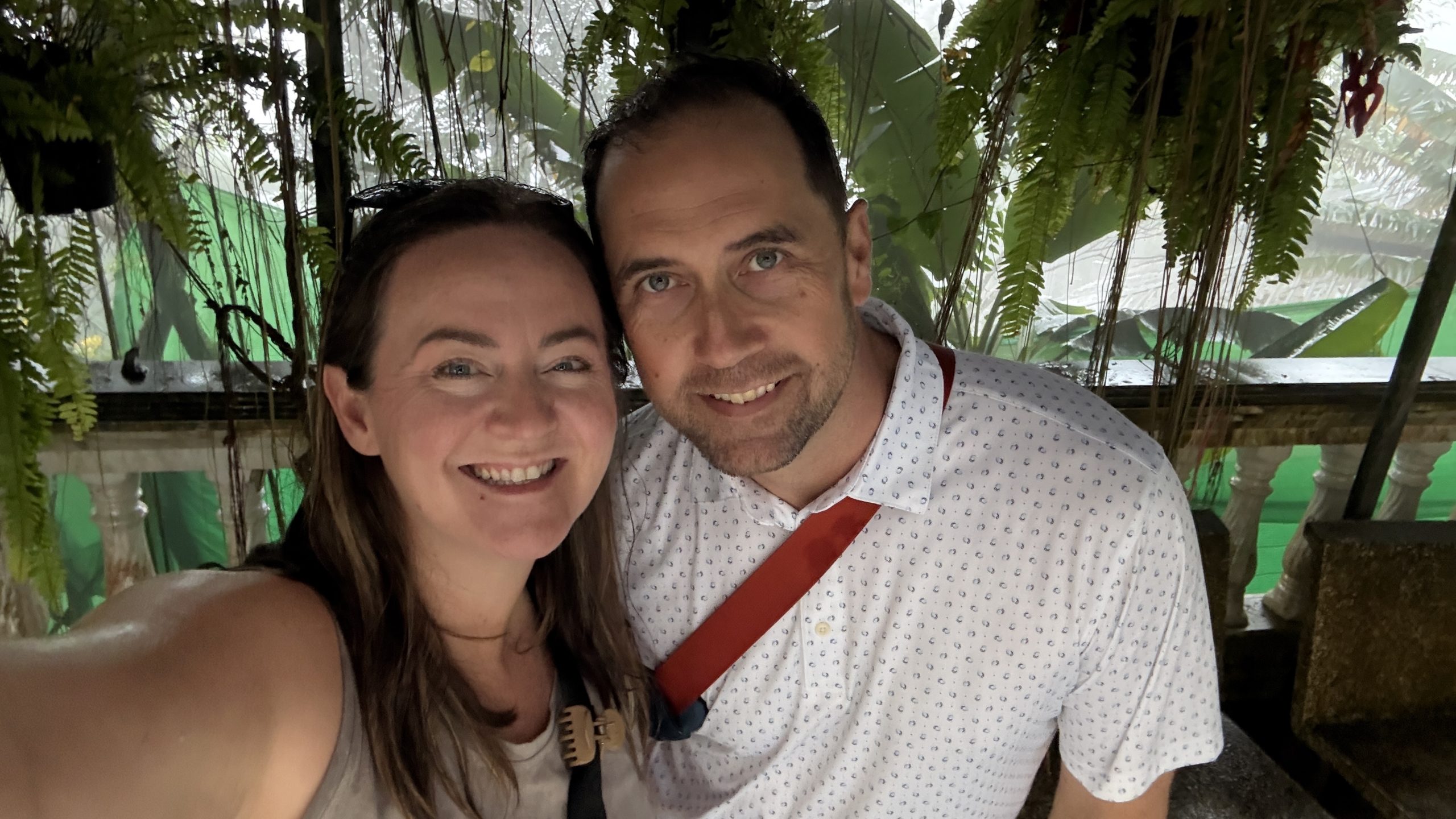
Morning: The Road to Chiang Mai (and Mild Group Drama)
We started the day expecting chaos — a long drive from Chiang Rai to Chiang Mai and a bit of lingering group tension from last night. That’s the thing with group trips: different personalities, different definitions of what acceptable behaviour looks like, and different expectations of the trip.
Our Air Canada Vacations itinerary has been more “guideline” than gospel. Our guide, Wasa, has been adding extra stops to make the experience richer, but not everyone’s into surprises or impromptu itinerary changes. A few people had booked a 2:30 p.m. cooking class only to learn construction delays meant we wouldn’t reach the hotel until 4. Cue the mild mutiny.
In the end, six people opted out of today’s temple visit, and the rest of us carried on.
And honestly? I’m so glad we did.
The drive was breathtaking. We followed the Lao River, watching the water shift from brown to glassy green as the landscape changed — cities fading to farmland, farmland giving way to dense jungle. Every bend felt like another layer: roadside markets, vine-covered cliffs, and people crossing the river by rope. Brent even spotted elephants from the bus window. ELEPHANTS. I missed it and may or may not have teared up about that.
At one point, I said, “Who needs guardrails anyway?” as we rounded a sharp curve (without guardrails…on a cliff). Mom misheard me as, “Who needs gargoyles anyway?” and repeated it so confidently that we nearly choked laughing. New family catchphrase unlocked.
It felt like the Cabot Trail, but make it jungle.
The Climb: Wat Phra That Doi Suthep
When you’ve seen this many temples, it takes a lot to stand out. But this one — Wat Phra That Doi Suthep — did.
Perched high on Doi Suthep mountain, it’s one of the most sacred sites in northern Thailand. It’s not just another golden pagoda for tourists; it’s a living, breathing place of worship for locals and easily my favourite temple we’ve visited.
On Visakha Bucha, thousands of Thai Buddhists make the 11km nighttime pilgrimage here, walking from the base of the mountain for several hours before even reaching the staircase — a 300-plus step climb flanked by jewelled naga serpents. It’s a celebration of devotion, endurance, and community, and imagining that made our own short visit feel different.
We skipped the 11 km hike but did climb the 300+ stairs, in the rain. You would think that would be a disappointment, but actually the rain made everything misty and cinematic (plus sent the usual crowds scurrying away) — bells jingling, clouds drifting through the jungle, and gold surfaces glistening in the rain. To be perfectly honest with you, I loved that it rained and felt like we got an extra special experience because of it.
At the top, Wasa explained that every temple has five essential elements: a chapel, monk’s residence, a Bodhi tree, pagoda, and library or learning hall. Once you know that, you start spotting them everywhere.
We’re also learning a ton about Monks. Did you know they don’t eat after 11 a.m., believing it keeps the mind clear for meditation. Also, if you’re a visitor, you walk clockwise around the temple as a sign of respect.
Once we made our way back down the steps, we sat with pink milk — a neon, sweet drink that tastes like melted strawberry ice cream — and watched the rain fall through the courtyard. It was one of those moments where everything slows down. It was also another opportunity to try a new food.
Would I order it again? Probably not. I’m not much for sweet drinks, but I’m glad I got to experience it.
Little Quirks & Observations
Thailand continues to fascinate me with the smallest details.
- We’ve noticed hotel cleaners always work barefoot and after a bit of digging, I’ve leanred that it’s a gesture of respect and quietness that feels oddly grounding.
- We’ve noticed signs banning durian and mangosteen in nearly every hotel and public space.
Durian, often called the king of fruits, has a smell that’s apparently so intense it’s actually outlawed in many indoor places — imagine onions, gasoline, and gym socks had a baby. You’ll see the “no durian” symbol right beside “no smoking.”
Mangosteen, meanwhile, is its complete opposite — sweet, fragrant, and gorgeous — but the deep purple rind stains everything it touches. One squeeze and your hotel sheets, hands, and soul are permanently tie-dyed.
Together, they’re kind of the yin and yang of Thai fruit culture: one banned for being too bold, the other for being too beautiful. And the ban has me itching to get my hands on them both to see what all the fuss is about 😉
- And even in the middle of nowhere, you’ll find the most beautifully designed coffee shops — sleek, calm, and somehow surviving in tiny roadside towns. I’m talking middle-of-nowhere cafes, that just pop up when you least expect them. It’s bizzare, in the best way possible.
It’s these contrasts, I think — reverence and chaos, tradition and trendiness — that make Thailand feel alive. It’s charming, unpretentious, a deeply soulful.
Dinner, Pad Thai & The Mustache Kid
By the time we reached WinTree City Resort, we were wrecked. The hotel’s gorgeous — a winding pool that snakes between the rooms, spacious suites, and the kind of service that makes you never want to leave. That quality has been par for the course on this trip and what’s really wild are the prices. 5 star hotels, for about $100/night. A hotel like this, in Halifax, would run you $500+.
Dinner was an easy call: stay put. My Pad Thai arrived wrapped in a delicate egg omelet, with sugar and chili flakes on the side so you can choose your own sweet & heat level. It was easily the best of the trip. And my eyeballs are still sweating!
A Japanese family sat beside us, and their little boy became instantly obsessed with Steve’s mustache. He was the kind of kid who I’m sure talks to everyone. He started off by waving frantically at each of us and would not let it go until he got acknowledgment from each one of us (easy to do, since he was so stinkin’ cute). We figured out quickly that he was enamoured with Steve’s mustache. He learned to say “mustache” in English, mimed it with his finger across his lip, and eventually climbed into Steve’s chair to surprise him. These are the moments that stick — no itinerary required.
The Elephant Debate
Tomorrow we’re visiting an elephant sanctuary, and I’ve been wrestling with the ethics of it all. If you read yesterday’s journal entry, you know where I stand on this kind of tourism.
I’ve sworn off most animal attractions — I haven’t been to a zoo in over a decade, would never swim with dolphins, and I can’t stomach things like bullfighting or rodeos. But travel with others means compromise, and one of our crew really wanted this.
After a lot of discussion (and help from Wasa), we’ve chosen a no-ride, rescue-based sanctuary — a place that claims to house elephants saved from circuses and logging work. Whether it’s truly ethical is hard to know, but I’m going with an open mind and a notebook full of questions.
There’s nuance here. Wild habitats are disappearing. Some of these elephants can’t safely return to the wild. Maybe the least-bad option is one where they’re cared for with dignity. Maybe not. I’ll report back tomorrow.
Bathrooms, Bidets & Barefoot Balance
Let’s talk about something not enough travel blogs do: toilets.
One of the most asked questions I’m getting is “how are the toilets?”. And, frankly, they’ve been largely better than ours. From what I can tell, there are a couple of things going on.
First, the Thai people clearly take great pride in their spaces, their service and making people feel comfortable. And, the bathrooms reflect that. Most washrooms we’ve encountered have been free to use, with a couple of exceptions where there’s a 5 baht charge (which is about 15 cents).
Secondly, every toilet we’ve encountered (except for the squat toilets) is fully equipped with a bidet or toilet hose, and it’s glorious. In my opinion, a bidet should be non-negotiable and is the most civilized way to use the washroom. North America, get your shit together. It’s cleaner, smarter, and I will die on this hill.
That said, we did encounter our first squat toilet today — a literal hole in the floor that begs the question, how the f*ck do you use it? Are women meant to take their pants completely off? How do you not get pee on the bottoms of your pants (without completely removing them)? What if you can’t squat? I’m convinced there’s an art to it, but I don’t know what it is.
I did not participate.
Conversations that Stick
After dinner, as I was sitting down to write this, Brent said something that perfectly sums up why we travel:
“I think a big purpose of travelling is connection — realizing that people from different cultures aren’t really all that different. Every trip changes us a little; it expands your tolerance and your acceptance.”
He’s right. Every place changes us — sometimes through awe, sometimes through discomfort, always through conversation.
Travel doesn’t just show you the world; it shows you yourself in it, I think.
Photo of the Day:
📸 Misty steps at Doi Suthep — rain, bells, jungle.
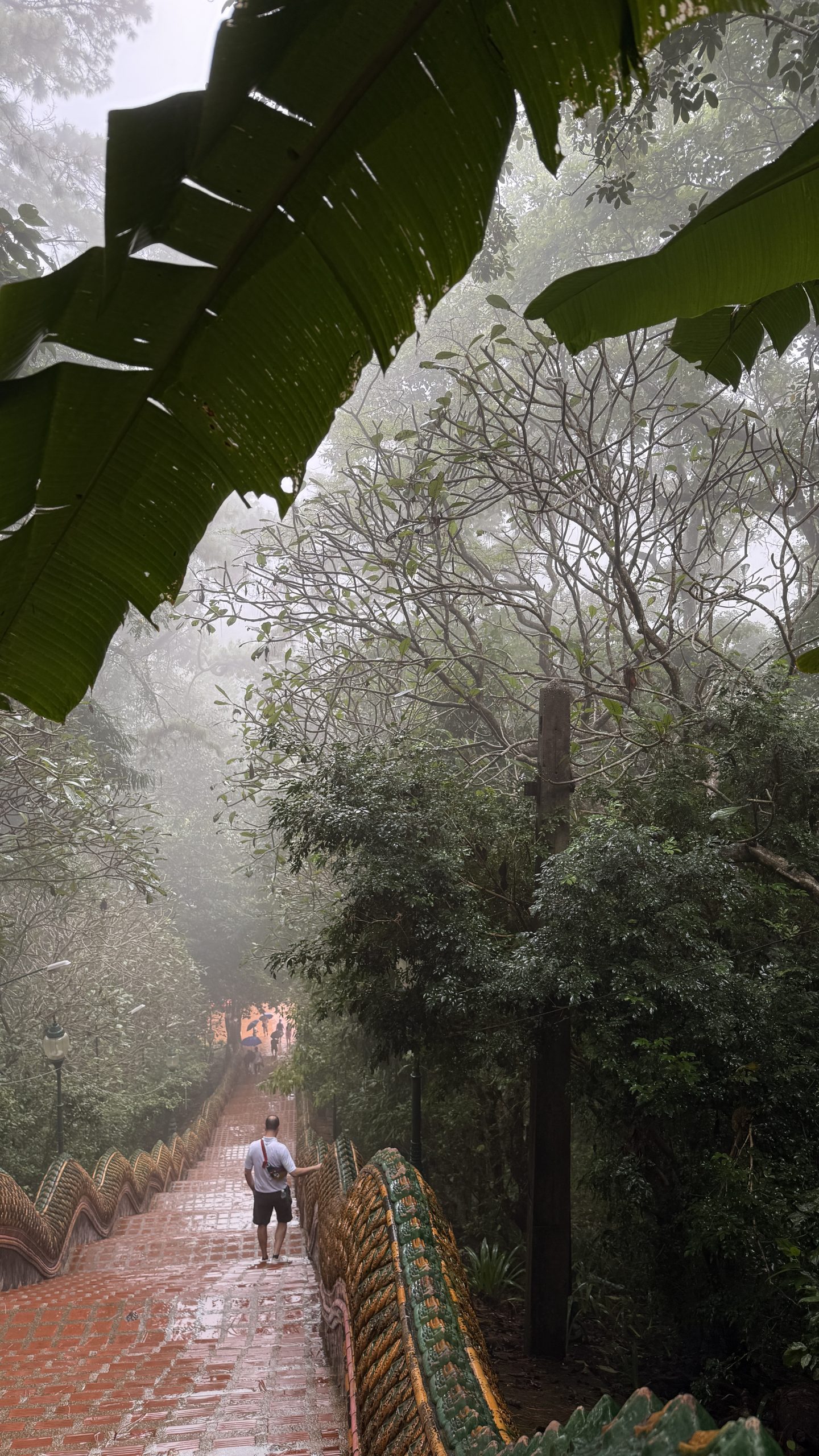
“Proof that magic usually lives just past the point of discomfort.”
✈️ Travel Tip of the Day
Doi Suthep hack: If you want the temple mostly to yourself, a rain shower or early/late visit helps. And if you’re here for Visakha Bucha, consider the overnight walk — even part of it.
Missed a day? Catch up here
👉 Day 1 – The Uber Ride from Hell
👉 Day 2 – The Lounge Life & the Struggle Bus
👉 Day 3 – Hot, Hotter, & Really F*ing Hot
👉 Day 4 – Floating Markets, Boat Noodles & the Great Coke Zero Explosion
👉 Day 5 – Heaven, Hell & the Hands at the White Temple
👉 Day 6 – Hill Tribes, Hard Truths & a Side of Curry
Let’s talk
What do you think about elephant sanctuaries, zoos, or animal tourism in general?
Where do you draw the line — or do you?
Tell me in the comments. I’m genuinely curious how other travellers navigate this stuff because I’m constantly re-evaluating my own stance.





I love this!!! “I think a big purpose of travelling is connection — realizing that people from different cultures aren’t really all that different. Every trip changes us a little; it expands your tolerance and your acceptance.”